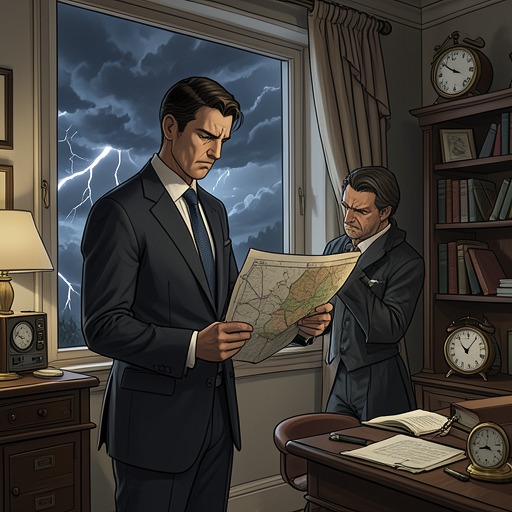
Garrett Roger Blackstone
The AxGarrett Roger Blackstone is a paper-industry manager and one of the résumé competitors Burke Devore considers a serious threat. The novel presents him chiefly through a document and the reports of a woman at his home, rather than through his own speech or actions. That distance matters: Burke turns Blackstone into a target on the strength of his qualifications, then learns that Blackstone has found the work he wanted and decides not to kill him.
Identity and Background
Blackstone’s name enters Burke’s field of attention as Garrett Roger Blackstone, abbreviated in Burke’s notes to GRB. The résumé identifies him as born in Marysville, New Jersey, on August 18, 1947. It lists his schooling in Marysville and Smithers, followed by a bachelor’s degree in art history from Rutgers University in New Brunswick in 1968. It also records three years in the United States Army, from 1968 to 1971, with postings in Texas, Vietnam, and Okinawa.
The document gives him a long career in the paper business. It describes twenty-six years of industry experience and eighteen years managing a broad range of paper manufacturing for a broad-based papermaker. Its clearest current position is plant manager at Green Valley Paper in Housatonic, Connecticut, a post the résumé dates from 1984 to the present. The combination of broad manufacturing experience and plant-level responsibility makes him more than a name in Burke’s files: on paper, he is a seasoned professional whose career matches the kind of work Burke seeks.
The Résumé and the Competition
Burke’s interest in Blackstone grows out of a labor market crowded with people displaced by downsizing. Halcyon Mills has cut its workforce at the Belial mill from 2,100 to 1,575, dropped Burke’s product line, and transferred its work to a Canadian affiliate. After twenty years with the company, Burke receives ten months’ pay under the severance arrangement, but the security of a former salary and benefits is temporary. Across industries, the number of companies dismissing workers exceeds the number hiring them, and applicants compete for fewer openings.
Burke knows that paper expertise is not the only qualification employers weigh. He believes he could manage almost any line in the industry with limited training, yet employers can choose applicants already trained for a precise function, often willing to accept lower pay and fewer benefits. His own applications usually bring no answer. As he studies the competing résumés, he distinguishes casual or badly aimed applicants from people whose experience and education could place them ahead of him. Blackstone belongs to that more threatening class: Burke judges his background very similar to his own, perhaps slightly stronger, and his education more impressive on the page.
The résumé also gives Burke a route from abstract competition to a particular person. It supplies a postal address at Scantic River Road in Erebus, Connecticut, and a telephone number. Burke drives through the area and searches for the address, eventually approaching the house by a path through the woods. The document that began as evidence of professional credentials has become the means by which Burke can locate the rival he has made responsible for his diminishing prospects.
The Intended Target
Burke’s surveillance is shaped by uncertainty about Blackstone’s circumstances. He has watched the house without seeing him and wonders whether Blackstone has separated from his wife or taken an interim job that keeps him away during the day. To resolve the uncertainty, Burke calls the house from a pay phone several miles before the turnoff to Scantic River Road. The possibility that the call will reveal a change in Blackstone’s employment becomes decisive: Burke needs to know whether the man is still available as a competitor before proceeding with his plan.
A woman answering the phone says that Blackstone has only just started at his new workplace. When Burke asks about it, she describes it as a wonderful job, the one Blackstone wanted. She identifies the employer as Willis and Kendall. The news makes Burke realize that Blackstone has obtained the position Burke regarded as his own. His response is not to continue the pursuit: he abandons the plan to kill him. He leaves the call pleased that Blackstone is employed in a post he wanted, even as the knowledge that two rivals remain unsettled weighs on him as he drives home.
Narrative Role and Significance
Blackstone is characterized less through an observed personality than through the gap between a résumé and the life Burke imagines from it. The résumé offers dates, schools, military service, and managerial experience; Burke supplies the danger, reading those qualifications as the profile of someone who might finish ahead of him. Blackstone himself is not shown competing with Burke, confronting him, or even knowing that Burke has been watching his home. The threat is constructed inside Burke’s increasingly narrowed view of employment as a contest in which another person’s success means his own defeat.
The phone call interrupts that logic without resolving Burke’s larger crisis. Blackstone’s new job provides a concrete reason for Burke to spare him: he is no longer simply an available rival but a man who has attained work he wanted. That distinction reveals the contingency in Burke’s plan. His violence is directed not indiscriminately at every qualified applicant, but at people he believes stand between him and employment; when Blackstone’s situation changes, Burke’s intended action changes too. Blackstone therefore functions as a decisive test of the boundary Burke draws between competition and murder, while remaining largely outside the private system of motives that makes him a target in the first place.